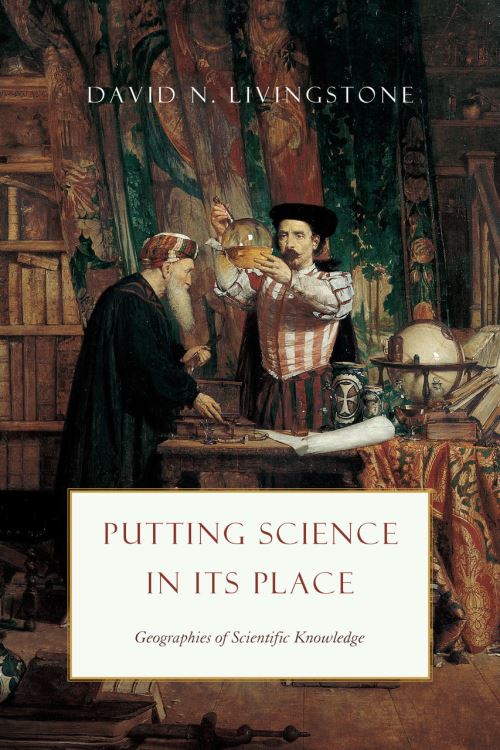
We are accustomed to thinking of science and its findings as universal. After all, one atom of carbon plus two of oxygen yields carbon dioxide in Amazonia as well as in Alaska; a scientist in Bombay can use the same materials and techniques to challenge the work of a scientist in New York; and of course the laws of gravity apply worldwide. Why, then, should the spaces where science is done matter at all? David N. Livingstone here puts that question to the test with his fascinating study of how science bears the marks of its place of production.
Putting Science in Its Place establishes the fundamental importance of geography in both the generation and the consumption of scientific knowledge, using historical examples of the many places where science has been practiced. Livingstone first turns his attention to some of the specific sites where science has been made-the laboratory, museum, and botanical garden, to name some of the more conventional locales, but also places like the coffeehouse and cathedral, ship's deck and asylum, even the human body itself. In each case, he reveals just how the space of inquiry has conditioned the investigations carried out there. He then describes how, on a regional scale, provincial cultures have shaped scientific endeavor and how, in turn, scientific practices have been instrumental in forming local identities. Widening his inquiry, Livingstone points gently to the fundamental instability of scientific meaning, based on case studies of how scientific theories have been received in different locales. Putting Science in Its Place powerfully concludes by examining the remarkable mobility of science and the seemingly effortless way it moves around the globe.
From the reception of Darwin in the land of the Maori to the giraffe that walked from Marseilles to Paris, Livingstone shows that place does matter, even in the world of science.
Buy from our bookstore and 25% of the cover price will be given to a school of your choice to buy more books. *15% of eBooks.
Frequently asked questions
We are accustomed to thinking of science and its findings as universal. After all, one atom of carbon plus two of oxygen yields carbon dioxide in Amazonia as well as in Alaska; a scientist in Bombay can use the same materials and techniques to challenge the work of a scientist in New York; and of course the laws of gravity apply worldwide.
Putting Science in Its Place features in the following genres: History of science
Paperback, Hardback. £18.00, down from the £20.00 cover price. Not Available.
Putting Science in Its Place was written by David N Livingstone and published by The University of Chicago Press an imprint of University of Chicago Press
Join our community for the latest bookish news, reading recommendations, exclusive opening extracts, author events and competitions. It\'s all free. And enter a monthly draw to win a £50 Gift Card. See past winners here