

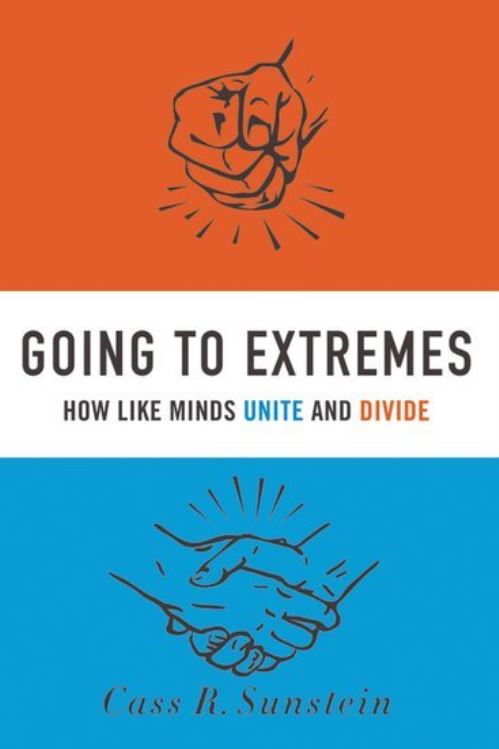
Why do people become extremists? What makes people become so dismissive of opposing views? Why is political and cultural polarization so pervasive in America?
In Going to Extremes, renowned legal scholar and best-selling author Cass R. Sunstein offers startling insights into why and when people gravitate toward extremism. Sunstein marshals a wealth of evidence that shows that when like-minded people gather in groups, they tend to become more extreme in their views than they were before.
Thus when liberals group get together to debate climate change, they end up more alarmed about climate change, while conservatives brought together to discuss same-sex unions become more set against same-sex unions. In courtrooms, radio stations, and chatrooms, enclaves of like-minded people are breeding ground for extreme movements. Indeed, Sunstein shows that a good way to create an extremist group, or a cult of any kind, is to separate members from the rest of society, either physically or psychologically.
Sunstein's findings help to explain such diverse phenomena as political outrage on the Internet, unanticipated "blockbusters" in the film and music industry, the success of the disability rights movement, ethnic conflict in Iraq and former Yugoslavia, and Islamic terrorism. Providing a wealth of real-world examples--sometimes entertaining, sometimes alarming--Sunstein offers a fresh explanation of why partisanship has become so bitter and debate so rancorous in America and abroad.
| ISBN: | 9780199754120 |
| Publication date: | 28th April 2011 |
| Author: | Cass R Sunstein |
| Publisher: | Oxford University Press an imprint of OUP USA |
| Format: | Paperback |
| Pagination: | 208 pages |
| Genres: |
Political structures: democracy Sociology Psychology |
Why do people become extremists? What makes people become so dismissive of opposing views?
Going to Extremes features in the following genres: Political structures: democracy, Sociology, Psychology
Paperback, Hardback, Ebook. Not Available.
Going to Extremes was written by Cass R Sunstein and published by Oxford University Press an imprint of OUP USA
Going to Extremes has 208 pages