

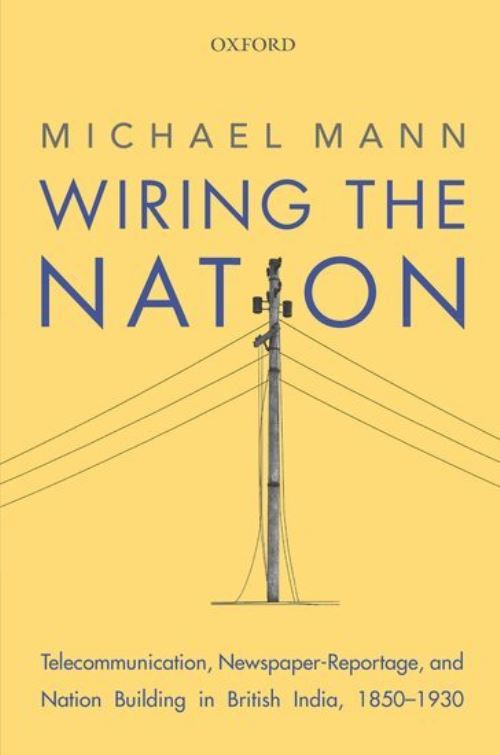
News today is understood as the most recent information available from places all over the world. It was the telegraph which gave birth to this understanding by profoundly transforming the global press landscape at the turn of the nineteenth century. Select information bought from agencies like Reuters, Wolff, Havas, and Associated Press made their way into newspapers-'news' became a commodity and journalism as we know it was born.
In British India, after the Great Rebellion of 1857-8 and with the end of the Mughal dynasty, the concept of a shared cultural community was lost. In the decades that followed, telegraphically disseminated news played a leading role in shaping an all-India public sphere, in the process resurrecting the idea of a unified nation-an idea that formed the basis of the anti-colonial struggle launched soon after. As Wiring the Nation traces the social, cultural, and political consequences of the telegraph in colonial India, this new mode of communication emerges not merely as a technological marvel, but also as a force with the power to influence the imagination of an entire nation.
| ISBN: | 9780199472178 |
| Publication date: | 14th September 2017 |
| Author: | Michael Mann |
| Publisher: | Oxford University Press an imprint of OUP India |
| Format: | Hardback |
| Pagination: | 324 pages |
| Genres: |
Colonialism and imperialism Media, entertainment, information and communication industries |
News today is understood as the most recent information available from places all over the world. It was the telegraph which gave birth to this understanding by profoundly transforming the global press landscape at the turn of the nineteenth century.
Wiring the Nation features in the following genres: Colonialism and imperialism, Media, entertainment, information and communication industries
Hardback. Not Available.
Wiring the Nation was written by Michael Mann and published by Oxford University Press an imprint of OUP India
Wiring the Nation has 324 pages