

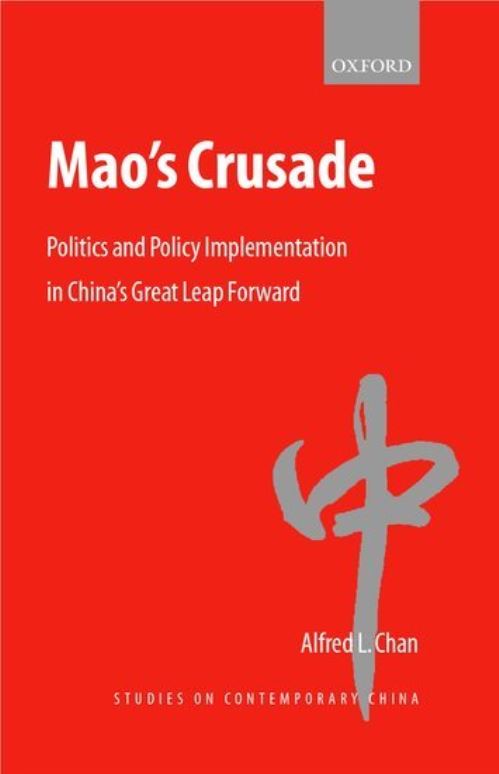
During 1957 and 1958 Mao was seized by a vision that the Chinese economy could develop rapidly in leaps and bounds by relying on intuition and mass spontaneity. As a consequence, he single-handedly launched a colossal mobilization campaign called the Great Leap Forward, which featured many radical policy innovations, including the people's communes. This book is the first in-depth and original study of policy formulation and implementation during the Leap to link the roles of Mao, the central leaders, the ministries, and the province of Guangdong.
Rejecting the theory that the Leap was an outcome of bureaucratic politics and competition, the study establishes beyond doubt the supreme and dominant position of Mao in initiating and commanding the Leap. Alfred L. Chan goes further than propounding a Mao-dominant model by documenting the strategic and tactical moves made by Mao in order to neutralize all opposition and to carry the day.
He also discusses in detail the policy roles and input of other top leaders on whom the improvising Mao relied to feed his imagination and to flesh out his policies. In the chapters on the implementation of the Leap, Dr Chan explores how the ministries of Metallurgy and Agriculture were transformed from bureaucratic agencies into agents of mobilization, and how impossible targets forced them to keep up appearances by focussing on the rituals of mass mobilization.
Similarly, other chapters on Guangdong show the simultaneously fervent, ritualistic, and desperate attempts to implement every hunch and intuition emanating from the centre. Exhaustive research using new material made available in the post-Mao era, as well as archives from the 1950s and 1960s, has yielded novel and original insights into the leader Mao, central decision-making, and policy implementation in the communist hierarchy.
| ISBN: | 9780199244065 |
| Publication date: | 7th June 2001 |
| Author: | Alfred Chan |
| Publisher: | Oxford University Press an imprint of OUP OXFORD |
| Format: | Hardback |
| Pagination: | 321 pages |
| Series: | Studies on Contemporary China |
| Genres: |
Political economy Asian history Politics and government |
During 1957 and 1958 Mao was seized by a vision that the Chinese economy could develop rapidly in leaps and bounds by relying on intuition and mass spontaneity. As a consequence, he single-handedly launched a colossal mobilization campaign called the Great Leap Forward, which featured many radical policy innovations, including the people's communes.
Mao's Crusade features in the following genres: Political economy, Asian history, Politics and government
Hardback. £186.75, down from the £207.50 cover price. Not Available.
Mao's Crusade was written by Alfred Chan and published by Oxford University Press an imprint of OUP OXFORD
Mao's Crusade has 321 pages
Yes it is part of Studies on Contemporary China series
£186.75, reduced from £207.50. Not Available.