

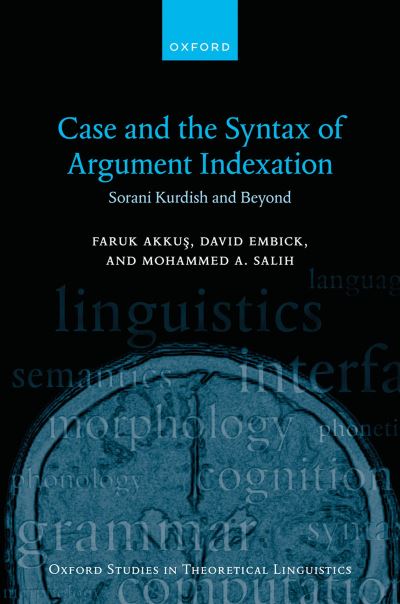
This book presents an analysis of argument indexation, the process by which arguments in a clause are coindexed with grammatical markers that bear their features. The main case study is based on varieties of Sorani Kurdish (in the Iranian language family), whose indexation properties interact with an alignment split of the type often called 'split Ergative.' From this, the authors develop a more general theory that can be applied to many other languages. A key line of argument is that agreement and clitic movement operations target specific cases, in a process called 'Case Targeting'. The approach further hypothesizes that case labels like 'Nominative', 'Ergative', and so on are shorthand for decomposed feature bundles. It is these features that are targeted by syntactic operations (agreement and movement). In addition to requiring Case Targeting, the analysis of Sorani implies that syntactic operations (agreement, clitic movement) and their morphophonological reflexes may be mismatched: agreement and movement can both produce affixes and clitics, contrary to many views of morphosyntax/morphophonology relations. The book offers a detailed exploration of the implications of this approach, particularly for theories of case assignment.
| ISBN: | 9780198962281 |
| Publication date: | 31st July 2025 |
| Author: | Faruk Akkus, David Embick, Mohammed A Salih |
| Publisher: | Oxford University Press an imprint of OUP OXFORD |
| Format: | Hardback |
| Pagination: | 352 pages |
| Series: | Oxford Studies in Theoretical Linguistics |
| Genres: |
Semantics, discourse analysis, stylistics Grammar, syntax and morphology |
This book presents an analysis of argument indexation, the process by which arguments in a clause are coindexed with grammatical markers that bear their features. The main case study is based on varieties of Sorani Kurdish (in the Iranian language family), whose indexation properties interact with an alignment split of the type often called 'split Ergative.' From this, the authors develop a more general theory that can be applied to many other languages. A key line of argument is that agreement and clitic movement operations target specific cases, in a process called 'Case Targeting'. The approach further hypothesizes that case labels like 'Nominative', 'Ergative', and so on are shorthand for decomposed feature bundles. It is these features that are targeted by syntactic operations (agreement and movement). In addition to requiring Case Targeting, the analysis of Sorani implies that syntactic operations (agreement, clitic movement) and their morphophonological reflexes may be mismatched: agreement and movement can both produce affixes and clitics, contrary to many views of morphosyntax/morphophonology relations. The book offers a detailed exploration of the implications of this approach, particularly for theories of case assignment.
Case and the Syntax of Argument Indexation features in the following genres: Semantics, discourse analysis, stylistics, Grammar, syntax and morphology
Case and the Syntax of Argument Indexation is available in Hardback
Case and the Syntax of Argument Indexation was written by Faruk Akkus, David Embick, Mohammed A Salih and published by Oxford University Press an imprint of OUP OXFORD
Case and the Syntax of Argument Indexation has 352 pages
Yes it is part of Oxford Studies in Theoretical Linguistics series