

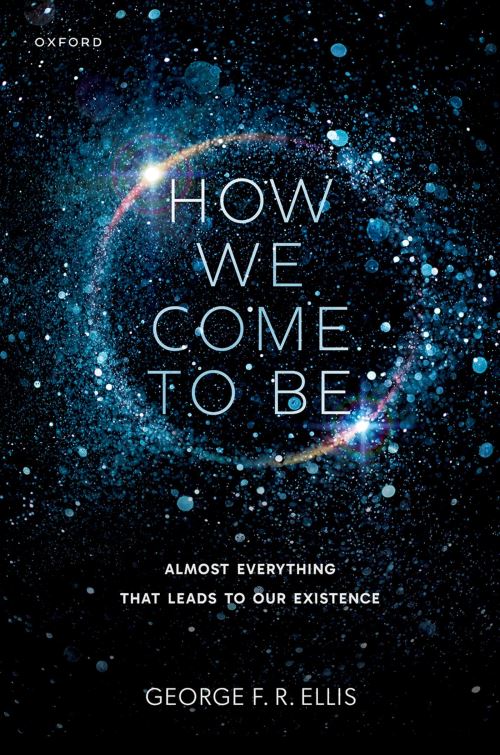
Our existence as living beings - thinking, feeling, acting - is an extraordinary thing: this book provides a scientifically based account of the entirety of factors that lead to our existence. The text begins with the physical foundations of our existence, examining the cosmological context of the vast expanding and evolving universe, enabling the existence of the Sun and the Earth. It goes on to summarise the underlying physics and chemistry, explaining behaviour on an atomic and molecular level, and considers the nature of biological emergence, arguing that all complex systems are modular hierarchical structures, allowing function to emerge at every level, and both upward and downward interactions occur between emergent levels.
The book then goes on to examine fundamental processes such as metabolism, dealing with material and energy needs, and homeostasis, stabilising the system against perturbing influences. At the molecular level, this is all enabled by change of shape of macromolecules, and the text looks at how we come into being by a combination of natural selection and developmental processes, which interact with each other and with physiology.
Finally, the book discusses the brain and mind, emphasizing the interaction of rationality and emotions, and examining the nature of mental causation and free will. It then delves into existence on a societal level, showing how social institutions having causal powers, and arguing that society can be understood as a homeostatic feedback system relating welfare to social, economic, political, and legal interactions. All social outcomes are determined crucially by our values, the nature of which can be represented by a spectrum of values ranging from very destructive and selfish to very constructive and generous.
The final chapter discusses whether meaning exists in the universe, providing evidence that the answer is yes, arguing for moral realism and the existence of a series of abstract possibility spaces that form the deep structure of the cosmos.
| ISBN: | 9780198950172 |
| Publication date: | 8th June 2026 |
| Author: | George F R Ellis |
| Illustrator: | M Carfora |
| Publisher: | Oxford University Press an imprint of OUP OXFORD |
| Format: | Hardback |
| Pagination: | 400 pages |
| Genres: |
Philosophy of science Impact of science and technology on society History of science |
Our existence as living beings - thinking, feeling, acting - is an extraordinary thing: this book provides a scientifically based account of the entirety of factors that lead to our existence. The text begins with the physical foundations of our existence, examining the cosmological context of the vast expanding and evolving universe, enabling the existence of the Sun and the Earth.
How We Come to Be features in the following genres: Philosophy of science, Impact of science and technology on society, History of science
Hardback. £22.50, down from the £25.00 cover price. Not Available.
How We Come to Be was written by George F R Ellis and published by Oxford University Press an imprint of OUP OXFORD
How We Come to Be has 400 pages
£22.50, reduced from £25.00. Not Available.