

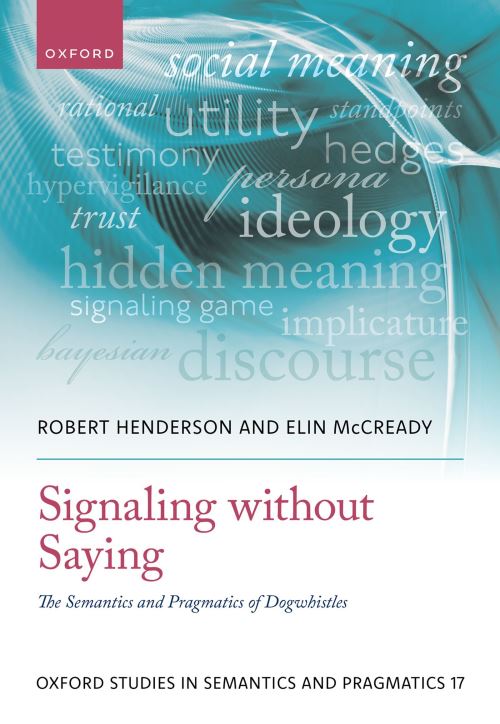
Signaling without Saying develops game-theoretic approaches to social meaning to model the phenomenon of dogwhistles, perhaps best known from political speech. These constructions involve language that sends one message to an out-group while at the same time sending a second-often taboo, controversial, or inflammatory-message to an in-group. Robert Henderson and Elin McCready show that dogwhistles should not be modeled in the same way as related language, like slurs, and nor should they be treated via standard Gricean implicatures computed over truth-conditional meaning; instead, they should be treated as primarily bearing social meaning, as understood by modern variationist sociolinguistic theories.
The book identifies and models two different kinds of dogwhistle meaning, while also exploring a variety of related phenomena. The authors show how novel implicatures in the social meaning domain can arise when a listener detects a dogwhistle, and connect them to implicatures familiar in the truth-conditional domain. Social meaning, they argue, can be added to theories of trust in testimonial evidence, and dogwhistles can help to establish trust with an audience, even when expressing false propositions.
The final chapter of the book looks at connections between dogwhistles and other issues important in epistemology and philosophy of language which might involve social meaning, such as standpoint theory.
| ISBN: | 9780198886341 |
| Publication date: | 4th July 2024 |
| Author: | Robert Henderson, Elin McCready |
| Publisher: | Oxford University Press an imprint of OUP OXFORD |
| Format: | Hardback |
| Pagination: | 166 pages |
| Series: | Oxford Studies in Semantics and Pragmatics |
| Genres: |
Philosophy of language Sociolinguistics Semantics, discourse analysis, stylistics |
Signaling without Saying develops game-theoretic approaches to social meaning to model the phenomenon of dogwhistles, perhaps best known from political speech. These constructions involve language that sends one message to an out-group while at the same time sending a second-often taboo, controversial, or inflammatory-message to an in-group.
Signaling Without Saying features in the following genres: Philosophy of language, Sociolinguistics, Semantics, discourse analysis, stylistics
Hardback. £72.00, down from the £80.00 cover price. Not Available.
Signaling Without Saying was written by Robert Henderson, Elin McCready and published by Oxford University Press an imprint of OUP OXFORD
Signaling Without Saying has 166 pages
Yes it is part of Oxford Studies in Semantics and Pragmatics series
£72.00, reduced from £80.00. Not Available.