

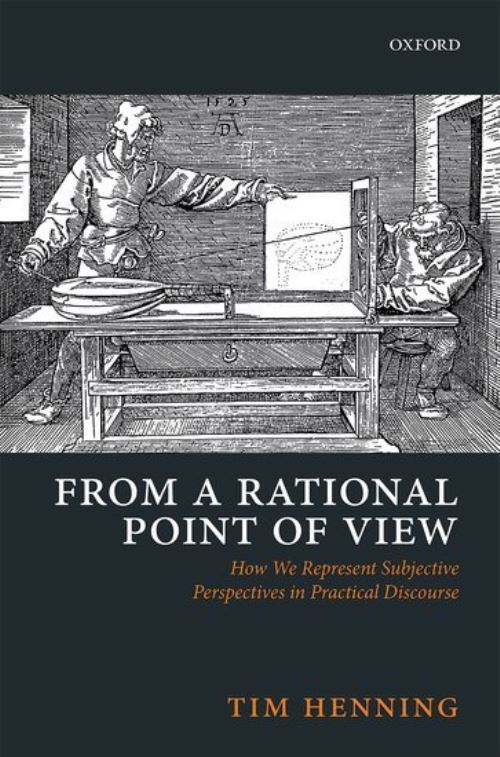
When discussing normative reasons, oughts, requirements of rationality, motivating reasons, and so on, we often have to use verbs like "believe" and "want" to capture a relevant subject's perspective. According to the received view about sentences involving these verbs, what they do is describe the subject's mental states. Many puzzles concerning normative discourse have to do with the role that mental states consequently appear to play in normative discourse.
Tim Henning uses tools from semantics and the philosophy of language to develop an alternative account of sentences involving these verbs. According to this view, which is called parentheticalism, we very commonly use these verbs in a parenthetical sense. These verbs themselves express backgrounded side-remarks on the contents they embed, and these latter, embedded contents constitute the at-issue contents.
This means that instead of speaking about the subject's mental states, we often use sentences involving "believe" and "want" to speak about the world from her point of view. Henning makes this notion precise, and uses it to solve various puzzles concerning normative discourse. The final result is a new, unified understanding of normative discourse, which gets by without postulating conceptual breaks between objective and subjective normative reasons, or normative reasons and rationality, or indeed between the reasons we ascribe to an agent and the reasons she herself can be expected to cite.
Instead of being connected to either subjective mental states or objective facts, all of these normative statuses are can be adequately articulated by citing worldly considerations from a subject's point of view.
| ISBN: | 9780198797036 |
| Publication date: | 5th June 2018 |
| Author: | Tim Henning |
| Publisher: | Oxford University Press an imprint of OUP OXFORD |
| Format: | Hardback |
| Pagination: | 252 pages |
| Genres: |
Philosophy of mind Ethics and moral philosophy Philosophy of language |
When discussing normative reasons, oughts, requirements of rationality, motivating reasons, and so on, we often have to use verbs like "believe" and "want" to capture a relevant subject's perspective. According to the received view about sentences involving these verbs, what they do is describe the subject's mental states.
From a Rational Point of View features in the following genres: Philosophy of mind, Ethics and moral philosophy, Philosophy of language
Hardback, Ebook. £78.30, down from the £87.00 cover price. Not Available.
From a Rational Point of View was written by Tim Henning and published by Oxford University Press an imprint of OUP OXFORD
From a Rational Point of View has 252 pages
£78.30, reduced from £87.00. Not Available.