

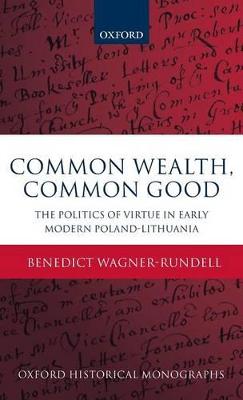
Common Wealth, Common Good is a study of the political discourse of the Commonwealth of Poland-Lithuania in the late seventeenth and early eighteenth centuries. It argues that the Polish-Lithuanian political tradition was preoccupied during this period with moral concepts, in particular that of public virtue, understood as the subordination of private interests to the common good. Polish-Lithuanian politicians and commentators analysed their politics primarily in moral terms, arguing that the Commonwealth existed for the promotion of virtue, and depended for its survival upon on the retention of virtue among rulers and citizens.
They analysed the acute political dysfunction that the Commonwealth experienced from the late seventeenth century as the result of corruption in the body politic. Proposals for reform of the Commonwealth's government aimed at reversing this corruption and restoring virtuous government in the service of the common good. Benedict Wagner-Rundell analyses the most important political treatises, including reform proposals, of the late seventeenth and early eighteenth century, to demonstrate how virtue was central to contemporaries' understanding of the Commonwealth and its situation.
He also argues that a concern with promoting virtue drove the development of local government during this period, and animated efforts for reform of the Commonwealth at the Sejm (Parliament) of 1712-13, and during the General Confederation of Tarnogród of 1715-17, a mass uprising by the Polish-Lithuanian nobility against King Augustus II. Placing the subject in international context, Common Wealth, Common Good argues that the Polish-Lithuanian political tradition's continuing preoccupation with virtue set it apart from republican traditions elsewhere in early-modern Europe and North America, where thinkers were beginning to consider whether self-interest could be harnessed as a positive political force.
The Polish-Lithuanian tradition's failure to match such developments elsewhere in Europe arguably demonstrates its backwardness: however, its emphasis on the need for political systems to be underpinned by shared values still has great relevance today.
| ISBN: | 9780198735342 |
| Publication date: | 5th March 2015 |
| Author: | Benedict First Secretary, First Secretary, British Embassy, Washington, DC WagnerRundell |
| Publisher: | Oxford University Press |
| Format: | Hardback |
| Pagination: | 204 pages |
| Series: | Oxford Historical Monographs |
| Genres: |
European history Social and cultural history Political leaders and leadership |
Common Wealth, Common Good is a study of the political discourse of the Commonwealth of Poland-Lithuania in the late seventeenth and early eighteenth centuries. It argues that the Polish-Lithuanian political tradition was preoccupied during this period with moral concepts, in particular that of public virtue, understood as the subordination of private interests to the common good.
Common Wealth, Common Good features in the following genres: European history, Social and cultural history, Political leaders and leadership
Hardback. £89.10, down from the £99.00 cover price. Not Available.
Common Wealth, Common Good was written by Benedict First Secretary, First Secretary, British Embassy, Washington, DC WagnerRundell and published by Oxford University Press
Common Wealth, Common Good has 204 pages
Yes it is part of Oxford Historical Monographs series
£89.10, reduced from £99.00. Not Available.