

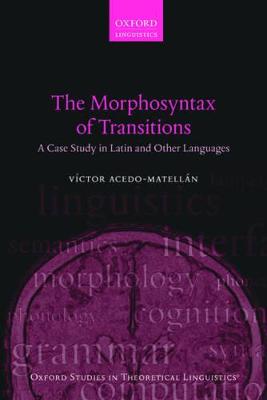
This book examines the cross-linguistic expression of changes of location or state, taking as a starting point Talmy's typological generalization that classifies languages as either 'satellite-framed' or 'verb-framed'. In verb-framed languages, such as those of the Romance family, the result state or location is encoded in the verb. In satellite-framed languages, such as English or Latin, the result state or location is encoded in a non-verbal element. These languages can be further subdivided into weak satellite-framed languages, in which the element expressing result must form a word with the verb, and strong satellite-framed languages, in which it is expressed by an independent element: an adjective, a prepositional phrase or a particle. In this volume, Víctor Acedo-Matellán explores the similarities between Latin and Slavic in their expression of events of transition: neither allows the expression of complex adjectival resultative constructions and both express the result state or location of a complex transition through prefixes. They are therefore analysed as weak satellite-framed languages, along with Ancient Greek and some varieties of Mandarin Chinese, and stand in contrast to strong satellite-framed languages such as English, the Germanic languages in general, and Finno-Ugric. This variation is expressed in terms of the morphological properties of the head that expresses transition, which is argued to be affixal in weak but not in strong satellite-framed languages. The author takes a neo-constructionist approach to argument structure, which accounts for the verbal elasticity shown by Latin, and a Distributed Morphology approach to the syntax-morphology interface.
| ISBN: | 9780198733287 |
| Publication date: | 18th February 2016 |
| Author: | Víctor Junior Research Fellow in Linguistics, Junior Research Fellow in Linguistics, Queens College, Universi AcedoMatellán |
| Publisher: | Oxford University Press |
| Format: | Hardback |
| Pagination: | 330 pages |
| Series: | Oxford Studies in Theoretical Linguistics |
| Genres: |
Grammar, syntax and morphology Historical and comparative linguistics |
This book examines the cross-linguistic expression of changes of location or state, taking as a starting point Talmy's typological generalization that classifies languages as either 'satellite-framed' or 'verb-framed'. In verb-framed languages, such as those of the Romance family, the result state or location is encoded in the verb. In satellite-framed languages, such as English or Latin, the result state or location is encoded in a non-verbal element. These languages can be further subdivided into weak satellite-framed languages, in which the element expressing result must form a word with the verb, and strong satellite-framed languages, in which it is expressed by an independent element: an adjective, a prepositional phrase or a particle. In this volume, Víctor Acedo-Matellán explores the similarities between Latin and Slavic in their expression of events of transition: neither allows the expression of complex adjectival resultative constructions and both express the result state or location of a complex transition through prefixes. They are therefore analysed as weak satellite-framed languages, along with Ancient Greek and some varieties of Mandarin Chinese, and stand in contrast to strong satellite-framed languages such as English, the Germanic languages in general, and Finno-Ugric. This variation is expressed in terms of the morphological properties of the head that expresses transition, which is argued to be affixal in weak but not in strong satellite-framed languages. The author takes a neo-constructionist approach to argument structure, which accounts for the verbal elasticity shown by Latin, and a Distributed Morphology approach to the syntax-morphology interface.
The Morphosyntax of Transitions features in the following genres: Grammar, syntax and morphology, Historical and comparative linguistics
The Morphosyntax of Transitions is available in Hardback
The Morphosyntax of Transitions was written by Víctor Junior Research Fellow in Linguistics, Junior Research Fellow in Linguistics, Queens College, Universi AcedoMatellán and published by Oxford University Press
The Morphosyntax of Transitions has 330 pages
Yes it is part of Oxford Studies in Theoretical Linguistics series
£96.75