

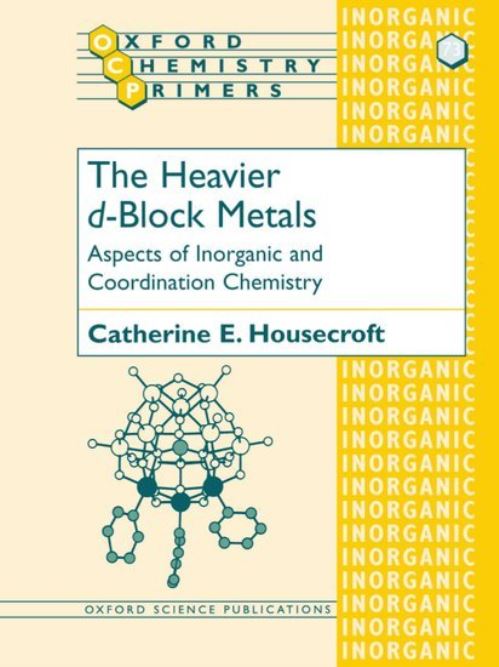
This book addresses the chemistry of the second and third row d-block metals, assuming a knowledge of the chemistry of the first row metals. Chapter 1 looks at the metals and summarizes occurrence, physical properties and uses. Chapter 2 considers periodic trends in properties.
Chapter 3 considers aqueous solution chemistry, species present (with comparisons of the first row metal ions) and redox properties. Chapter 4 surveys structure:
| ISBN: | 9780198501039 |
| Publication date: | 4th February 1999 |
| Author: | Catherine E Housecroft |
| Publisher: | Oxford University Press an imprint of OUP OXFORD |
| Format: | Paperback |
| Pagination: | 96 pages |
| Series: | Oxford Chemistry Primers |
| Genres: |
History of science Popular Science |
This book addresses the chemistry of the second and third row d-block metals, assuming a knowledge of the chemistry of the first row metals. Chapter 1 looks at the metals and summarizes occurrence, physical properties and uses.
The Heavier D-Block Metals features in the following genres: History of science, Popular Science
Paperback. £29.69, down from the £32.99 cover price. Not Available.
The Heavier D-Block Metals was written by Catherine E Housecroft and published by Oxford University Press an imprint of OUP OXFORD
The Heavier D-Block Metals has 96 pages
Yes it is part of Oxford Chemistry Primers series
£29.69, reduced from £32.99. Not Available.