

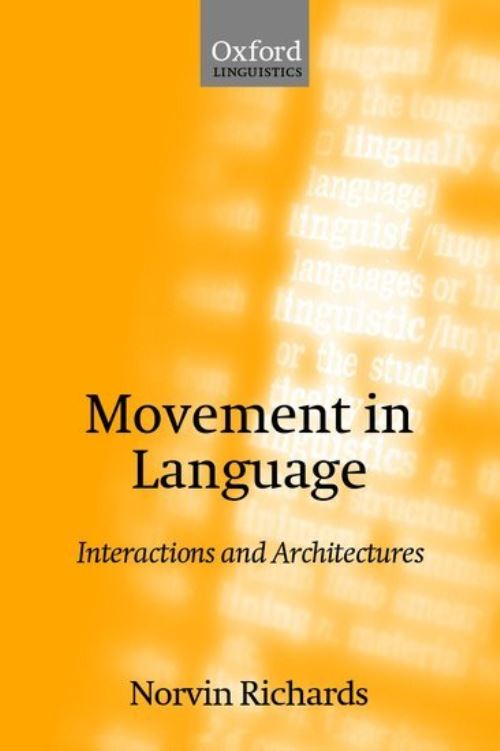
This book is the most comprehensive, integrated explanatory account yet published of the properties of question formations and their variation across languages. It makes an important contribution to the current debate over whether syntax should be understood derivationally, arguing that the best model of language is one in which sentences are constructed in a series of operations that precede or follow each other in time.
The central problem it addresses is the nature of the difference between (a) languages in which all wh-words move overtly to a clause-initial position (exemplified by Bulgarian); (b) languages in which one wh-phrase moves per clause but all others remain in situ (exemplified by English); and (c) languages in which there is no overt movement at all (exemplified by Japanese). Professor Richards focuses on the nature of syntactic movement in order to see what this reveals about the syntactic derivation.
He considers the nature of interactions between movement operations and investigates the behaviour of multiple overt wh-movement, scrambling, cliticization, and object shift. His general conclusions about the relationship between movement and multiple specifiers follow straightforwardly from basic principles of Shortest Move and Shortest Attract. He develops a PF-imposed well-formedness condition on movement chains (essentially, a requirement that a single member of the chain be unambiguously identified as the copy to be pronounced), which allows for the development of theories of anti-agreement, the that-trace effect, and the conditions on participial agreement in Romance, among other phenomena.
He defends the claim that well-formed dependencies can improve the status of ill-formed dependencies created later in the derivation, illustrating the explanatory power, under certain structural conditions, of his Principle of Minimal Compliance. He uses data on the locality of wh-movement to argue that the Principle of Minimal Compliance is responsible for a number of the apparent distinctions between overt and covert movement.
This book will interest syntacticians at graduate level and above as well as linguistic theorists concerned with the syntax-semantics interface.
| ISBN: | 9780198241171 |
| Publication date: | 25th October 2001 |
| Author: | Norvin Richards |
| Publisher: | Oxford University Press an imprint of OUP OXFORD |
| Format: | Hardback |
| Pagination: | 326 pages |
| Series: | Oxford Linguistics |
| Genres: |
Grammar, syntax and morphology |
This book is the most comprehensive, integrated explanatory account yet published of the properties of question formations and their variation across languages. It makes an important contribution to the current debate over whether syntax should be understood derivationally, arguing that the best model of language is one in which sentences are constructed in a series of operations that precede or follow each other in time.
Movement in Language features in the following genres: Grammar, syntax and morphology
Hardback. £55.80, down from the £62.00 cover price. Not Available.
Movement in Language was written by Norvin Richards and published by Oxford University Press an imprint of OUP OXFORD
Movement in Language has 326 pages
Yes it is part of Oxford Linguistics series
£55.80, reduced from £62.00. Not Available.