

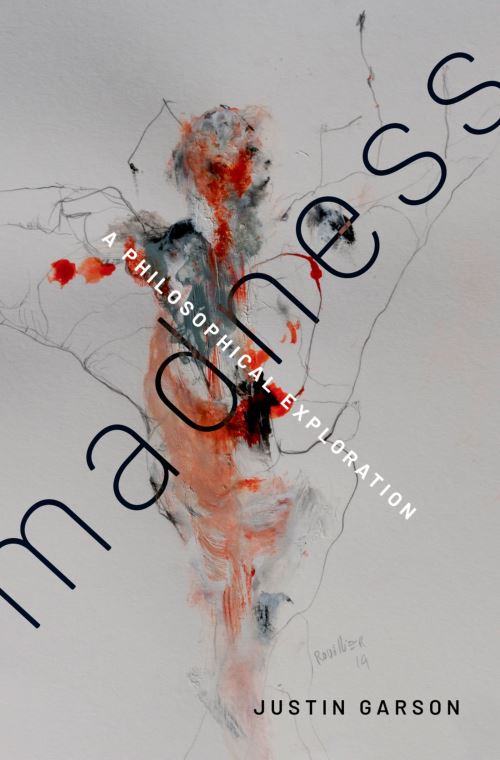
Since the time of Hippocrates, madness has typically been viewed through the lens of disease, dysfunction, and defect. Madness, like all other disease, happens when something in the mind, or in the brain, does not operate the way that it should or as nature intended. In this paradigm, the role of the healer is simply to find the dysfunction and fix it.
This remains the dominant perspective in global psychiatry today. In Madness: A Philosophical Exploration, philosopher of science Justin Garson presents a radically different paradigm for conceiving of madness and the forms that it takes. In this paradigm, which he calls madness-as-strategy, madness is neither a disease nor a defect, but a designed feature, like the heart or lungs.
That is to say, at least sometimes, when someone is mad, everything inside of them is working exactly as it should and as nature intended. Through rigorous engagement with texts spanning the classical era to Darwinian medicine, Garson shows that madness-as-strategy is not a new conception. Thus, more than a history of science or a conceptual genealogy, Madness is a recovery mission.
In recovering madness-as-strategy, it leads us beyond today's dominant medical paradigm toward a very different form of thinking and practice. This book is essential reading for philosophers of medicine and psychiatry, particularly for those who seek to understand the nature of health, disease, and mental disorder. It will also be a valuable resource for historians and sociologists of medicine for its innovative approach to the history of madness.
Most importantly, it will be useful for mental health service users, survivors, and activists, who seek an alternative and liberating vision of what it means to be mad.
| ISBN: | 9780197781319 |
| Publication date: | 5th February 2025 |
| Author: | Justin Garson |
| Publisher: | Oxford University Press an imprint of OUP USA |
| Format: | Paperback |
| Pagination: | 304 pages |
| Genres: |
Medical ethics and professional conduct Bioethics Psychiatry Philosophy of science |
Since the time of Hippocrates, madness has typically been viewed through the lens of disease, dysfunction, and defect. Madness, like all other disease, happens when something in the mind, or in the brain, does not operate the way that it should or as nature intended.
Madness features in the following genres: Medical ethics and professional conduct, Bioethics, Psychiatry, Philosophy of science
Paperback, Hardback, Ebook. £26.99, down from the £29.99 cover price. Not Available.
Madness was written by Justin Garson and published by Oxford University Press an imprint of OUP USA
Madness has 304 pages
£26.99, reduced from £29.99. Not Available.