

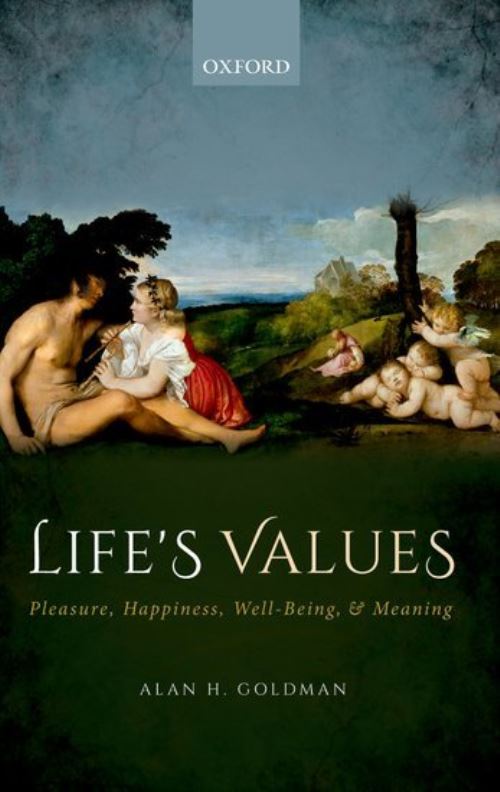
In Life's Values Alan H. Goldman seeks to explain what is of ultimate value in individual lives. The proposed candidates include pleasure, happiness, meaning, and well-being.
Only the latter is the all-inclusive category of personal value, and it consists in the satisfaction of deep rational desires. Since individuals' rational desires differ, the book cannot dictate what will maximize your own well-being and what in particular you ought to pursue. However it can tell you to make your desires rational (that is, informed and coherent) and it can also explain the nature of these states that typically enter into well-being: pleasure, happiness, and meaning being typically partial causes as well as effects of well-being.
All are by-products of satisfying rational desires and rarely successfully aimed at directly. Pleasure comes in sensory, intentional, and pure feeling forms, each with an opposite in pain or distress. Happiness in its primary sense is an emotion, not a constant state as some philosophers assume, and in secondary senses a mood (disposition to have an emotion) or temperament (disposition to be in a mood).
Meaning in life is a matter of events in one's life fitting into intelligible narratives. Events in narratives are understood teleologically as well as causally, in terms of outcomes aimed at as well antecedent events. So, in the briefest terms, this book distinguishes and relates pleasure, happiness, well-being, and meaning, and relates each to motivation and value.
| ISBN: | 9780192857019 |
| Publication date: | 1st October 2021 |
| Author: | Alan H Goldman |
| Publisher: | Oxford University Press an imprint of OUP OXFORD |
| Format: | Paperback |
| Pagination: | 208 pages |
| Genres: |
Philosophy of mind Ethics and moral philosophy Psychology |
In Life's Values Alan H. Goldman seeks to explain what is of ultimate value in individual lives.
Life's Values features in the following genres: Philosophy of mind, Ethics and moral philosophy, Psychology
Paperback, Hardback, Ebook. £22.49, down from the £24.99 cover price. Not Available.
Life's Values was written by Alan H Goldman and published by Oxford University Press an imprint of OUP OXFORD
Life's Values has 208 pages
£22.49, reduced from £24.99. Not Available.