

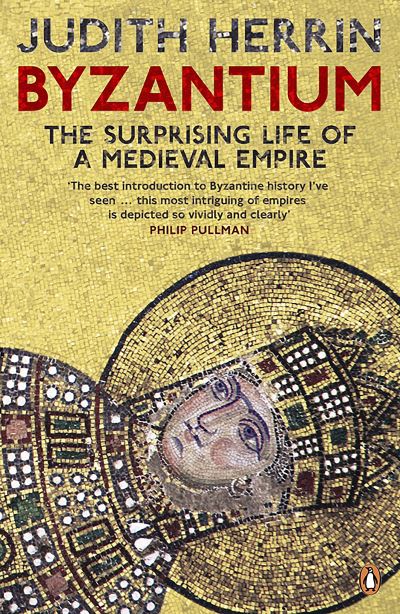
For a thousand years an extraordinary empire made possible Europe's transition to the modern world: Byzantium. An audacious and resilient but now little known society, it combined orthodox Christianity with paganism, classical Greek learning with Roman power, to produce a great and creative civilization which for centuries held in check the armies of Islam.
Judith Herrin's concise and compelling book replaces the standard chronological approach of most histories of Byzantium. Instead, each short chapter is focused on a theme, such as a building (the great church of Hagia Sophia), a clash over religion (iconoclasm), sex and power (the role of eunuchs), an outstanding Byzantine individual (the historian Anna Komnene), a symbol of civilization (the fork), a battle for territory (the crusades). In this way she makes accessible and understandable the grand sweeps of Byzantine history, from the founding of its magnificent capital Constantinople (modern Istanbul) in 330, to its fall to the Ottoman Turks in 1453.
| ISBN: | 9780141031026 |
| Publication date: | 3rd April 2008 |
| Author: | Judith Herrin |
| Publisher: | Penguin Books an imprint of Penguin Books Ltd |
| Format: | Paperback |
| Pagination: | 391 pages |
| Genres: |
European history: medieval period, middle ages European history |
For a thousand years an extraordinary empire made possible Europe's transition to the modern world: Byzantium. An audacious and resilient but now little known society, it combined orthodox Christianity with paganism, classical Greek learning with Roman power, to produce a great and creative civilization which for centuries held in check the armies of Islam.
Byzantium features in the following genres: European history: medieval period, middle ages, European history
Paperback, Ebook. £13.49, down from the £14.99 cover price. In Stock.
Byzantium was written by Judith Herrin and published by Penguin Books an imprint of Penguin Books Ltd
Byzantium has 391 pages
£13.49, reduced from £14.99. In Stock.