

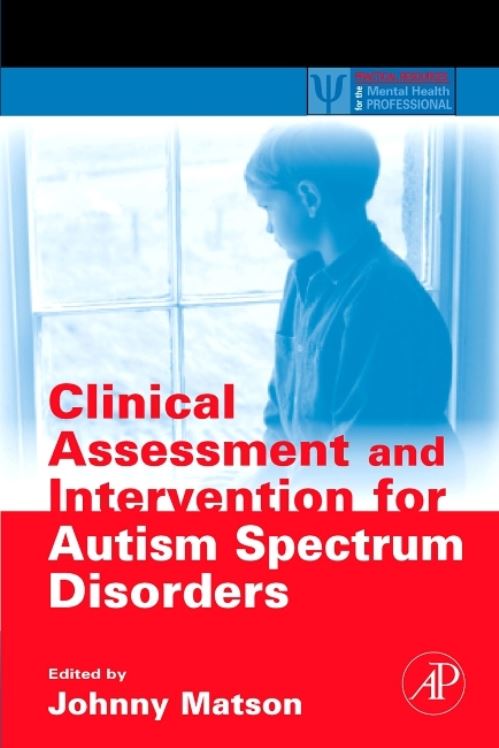
Autism spectrum disorder has received increasing research in recent years, with more information on assessment and treatment than can be readily assimilated from primary literature by clinicians. Clinical Assessment and Intervention for Autism Spectrum Disorders summarizes evidence-based assessments and intervention for Autism across the life-span, providing clinicians with a practical overview of how best to assess and treat this disorder.
The book begins with a discussion of what warrants a determination of being "evidence based" and a description of the disorder from a life span perspective. The book also provides a chapter on differential diagnosis of autism relative to other disorders. What follows are separate sections on assessment and intervention.
These chapters discuss first how to assess and then separately how to treat behavioral problems, communication and social skills issues, academic and vocational skills, and the use of pharmacology and an assessment of possible pharmacological effects. Intended for practitioners assessing and treating children with developmental delays, the book provides clinicians with best practices for assessing and treating delays associated with autism.
| ISBN: | 9780123736062 |
| Publication date: | 9th April 2008 |
| Author: | Johnny L Matson |
| Publisher: | Academic Press an imprint of Elsevier Science |
| Format: | Hardback |
| Pagination: | 428 pages |
| Series: | Practical Resources for the Mental Health Professional |
| Genres: |
Child, developmental and lifespan psychology Psychotherapy: counselling Educational psychology Neurology and clinical neurophysiology Clinical psychology |
Autism spectrum disorder has received increasing research in recent years, with more information on assessment and treatment than can be readily assimilated from primary literature by clinicians. Clinical Assessment and Intervention for Autism Spectrum Disorders summarizes evidence-based assessments and intervention for Autism across the life-span, providing clinicians with a practical overview of how best to assess and treat this disorder.
Clinical Assessment and Intervention for Autism Spectrum Disorders features in the following genres: Child, developmental and lifespan psychology, Psychotherapy: counselling, Educational psychology, Neurology and clinical neurophysiology, Clinical psychology
Hardback. Not Available.
Clinical Assessment and Intervention for Autism Spectrum Disorders was written by Johnny L Matson and published by Academic Press an imprint of Elsevier Science
Clinical Assessment and Intervention for Autism Spectrum Disorders has 428 pages
Yes it is part of Practical Resources for the Mental Health Professional series