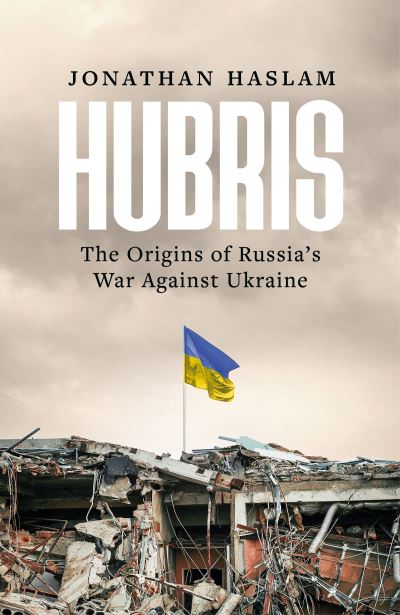
"On 24 February 2022, Russia launched a full-scale invasion of Ukraine in an escalation of the Russo-Ukraine conflict that began eight years earlier. In this detailed, analytical study, we learn how the roots of this conflict began long before that historic date. "
Hubris: The Tragedy of War in the Twentieth Century is a deeply analytical and thought-provoking exploration of how naive self-belief, coupled at times with sheer arrogance, has shaped military and political decision-making in the last century. The author is a renowned historian with a keen eye for ideological and strategic nuance who traces a consistent thread of hubris - excessive pride or self-confidence - from the First World War through to the Cold War, highlighting how leaders on all sides succumbed to self-deception, misjudged their adversaries, and overestimated their personal capabilities.
What makes Hubris stand out is the author’s skilful integration of political theory, diplomatic history and his military analysis. He doesn't just recount events, he probes the underlying psychology of leadership and the ideological rigidity that, history has shown us, often leads to disaster. Whether discussing the inflexibility of German military planners in 1914, the blind spots of Stalin and Hitler, or the miscalculations of the United States in Vietnam and Iraq, Haslam argues that arrogance often springs not from strength, but from a wilful ignorance of complex realities.
This book is densely packed with insight. As a reader, persistence is required and a willingness to follow its intellectually rigorous path. At times, Haslam’s prose is academic in style, but perseverance will reward the patient reader with a clearer understanding of how tragic patterns of behaviour repeat across different eras and regimes.
Ultimately, Hubris is not just a historical study, it’s a cautionary tale. Haslam offers a compelling argument to persuade the reader that leaders often fail, not because of poor intentions or insufficient intelligence, but because they become constrained by the information they are fed and by their own assumptions. For anyone interested in military history, international relations, or the psychology of power, Hubris is an essential, if sobering, read.

On 24 February 2022, Russia launched a full-scale invasion of Ukraine in an escalation of the Russo-Ukraine conflict that began eight years earlier. But the roots of the conflict began long before that historic date.The origins of the Russo-Ukrainian War can be traced back through a sequence of events to the early 1990s that lead us not to Russia or Ukraine, but to the other side of the Atlantic. In 1994, the White House, under President Clinton, embarked upon the expansion of NATO, urged on by the new governments of Poland, the Czech Republic and Hungary, who sought the security NATO could offer against Russia. Even at this early stage, the United States was secretly considering Ukraine for membership. When the likelihood of this emerged, President Putin of Russia made absolutely clear that this was a red line not to be crossed. But few expected the war that eventually came.In Hubris, Jonathan Haslam, one of the world's greatest experts on Russian foreign policy and espionage, examines one of the most intractable issues of our time.
| Primary Genre | History |
| Other Genres: |
On 24 February 2022, Russia launched a full-scale invasion of Ukraine in an escalation of the Russo-Ukraine conflict that began eight years earlier. But the roots of the conflict began long before that historic date.The origins of the Russo-Ukrainian War can be traced back through a sequence of events to the early 1990s that lead us not to Russia or Ukraine, but to the other side of the Atlantic.
Hubris features in the following genres: History, History, History and Archaeology, Earth Sciences, Geography, Environment, Planning, Geography, Human geography, Political, socio-economic, cultural and strategic groupings
Paperback, Hardback. £25.19, down from the £27.99 cover price. In Stock.
Hubris was written by Jonathan Haslam and published by Apollo an imprint of Bloomsbury Publishing (UK)
Hubris has 368 pages
£25.19, reduced from £27.99. In Stock.