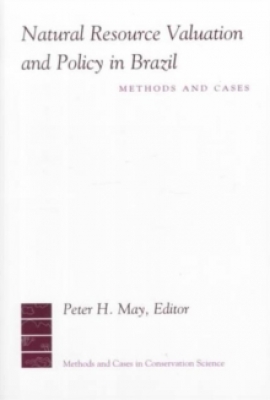
Brazil's environmental problems, especially Amazon deforestation, have attracted considerable attention, particularly in the developed world. Peter May brings a sharper and more critical focus to bear on this topic by offering a general overview and seven microeconomic case studies on particular problems in the Brazilian environment. Focusing on discrete resource problems at a subnational scale, this practical book shows how work at the state and local level can lead to more sustainable development policies not only in Brazil but also in many other developing nations.
Uniting specific Brazilian applications of more general principles of natural resource and environmental valuation to support policy-making for land use and economic development, Natural Resource Valuation and Policy in Brazil shows how such methods support efforts to incorporate environmental concerns in decision-making processes.
| ISBN: | 9780231108270 |
| Publication date: | 11th January 2000 |
| Author: | Peter May |
| Publisher: | Columbia University Press |
| Format: | Paperback |
| Pagination: | 352 pages |
| Series: | Issues, Cases, and Methods in Biodiversity Conservation |
| Primary Genre | Nature and the natural world: general interest |
| Other Genres: |
Brazil's environmental problems, especially Amazon deforestation, have attracted considerable attention, particularly in the developed world. Peter May brings a sharper and more critical focus to bear on this topic by offering a general overview and seven microeconomic case studies on particular problems in the Brazilian environment.
Natural Resource Valuation and Policy in Brazil features in the following genres: Nature and the natural world: general interest, Sustainability, Lifestyle, Hobbies and Leisure, The environment, Earth Sciences, Geography, Environment, Planning
Paperback. Not Available.
Natural Resource Valuation and Policy in Brazil was written by Peter May and published by Columbia University Press
Natural Resource Valuation and Policy in Brazil has 352 pages
Yes it is part of Issues, Cases, and Methods in Biodiversity Conservation series