LoveReading Says
LoveReading Says
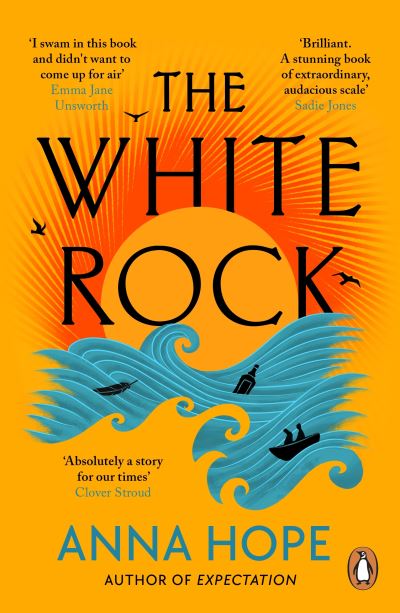
Poetic and reflective, Anna Hope’s The White Rock explores four stories spanning three hundred years, each of them set around the White Rock, a sacred site off the Pacific coast of Mexico.
Circles of experiences and history emanate from the rock through time, and novel’s clever circular structure emulates this — chapters focussing on each of the four timeframes pivot around a chapter called The White Rock, as the characters’ lives pivot around the real rock. As a whole, the stories are like rings of rippling water, with the rock providing gravitational pull for the characters, while also holding the novel together.
In 2020 a British writer and her soon-to-be-ex-husband have journeyed to the rock to give thanks for the birth of the child they never expected to have, just as the COVID pandemic takes hold. In 1969, a young, wild American music star on the run hopes to find (or maybe lose) himself at the rock. In 1907, an indigenous Yoeme girl is taken by force.
In 1775, a Spanish naval officer is engaged in the conquest of the coast. And the White Rock is a sacred, silent witness to each of their powerful stories.
The rock, and this structure, also provide the author with a means of exploring human commonalities across hugely different centuries — the mistakes we make, the losses we endure, the love and violence that bites our hearts and souls. With each set of stories swimming in emotion, this is a novel to take your time over, allowing its wisdom to sink in.

Reviewed by Joanne OwenJoanne Owen’s lifelong love of reading and writing began when she was growing up in Pembrokeshire, and very much wished that witches (and Mrs Pepperpot) were real.
More reviews by Joanne Owen Find This Book In
About
The White Rock Synopsis
FROM THE BESTSELLING AUTHOR OF THE BALLROOM AND EXPECTATION
They are separating, she and her husband, after two decades together.
This fact is new.
There are many ways of telling the tale ...
There are many different sides to every story ...
A minibus journeys through rural Mexico. Inside it are twelve strangers on a pilgrimage to the White Rock, which stands, ancient and sacred, off the Pacific coast. Like many before them, over centuries and from across continents, they find themselves irresistibly drawn here, for answers, to give thanks, to seek protection.
One of them is a writer. She is travelling with her husband and young daughter, as her faith in her marriage, and the future itself, is foundering. She has come to the White Rock in the hope of excavating a beginning from the rubble of many different endings.
Here she will find the echoes of many stories: of conquest and resistance, of betrayal and belief, of the many different forms of violence and love. Stories that have already unravelled, and stories that might yet illuminate a passage through these uncertain times ...
'An eco-novel you actually want to read' The Times
'Its narrative sweep is capacious . . . It has ambition to match, musing on freedom and reciprocity [and] the redemptive power of storytelling. Impressive' Observer
'Deeply moving' The i
About This Edition
| ISBN: |
9780241995495 |
| Publication date: |
18th May 2023 |
| Author: |
Anna Hope |
| Publisher: |
Penguin Books an imprint of Penguin Books Ltd |
| Format: |
Paperback |
| Pagination: |
287 pages |
| Primary Genre |
General Fiction
|
| Other Genres: |
|
Press Reviews
Anna Hope Press Reviews
'Mysterious and beautiful. It reminded me of Cloud Atlas, but it's very much itself: so bold and wild, but controlled and fierce. It's stunning writing and it has left me with hope, that we can tell stories like these even as the carbon builds, and that imagination and ideas remain powerful and valid' - Russell T. Davies, writer of It's A Sin
Brilliant. A stunning book of extraordinary, audacious scale. - Sadie Jones, author of The Snakes
I loved it. I became invested in each of the different eras and was struck by the sense of unknowable forces outliving us all. It is full of wisdom, intricate and emotional, and it will linger in my head for a long time. - Dave Haslam, author of Sonic Youth Slept On My Floor
Anna Hope is such a generous and sensitive writer, and The White Rock is full of extraordinary voices and ideas. Absolutely a story for our times, and a fiercely important one, too - Clover Stroud, author of The Red of my Blood
I loved the sparseness, the moments of poetry, the quiet brutality. The voice throughout is fierce and graceful and utterly compelling; each central character is rich and beautifully pinpointed. It is her strongest work yet. - Melody Razak, author of Moth
The White Rock is a sublime, poetic, and visionary work of art. - Ron Rash, author of In the Valley
Full of wisdom about the blink-and-you'll-miss-it nature of our lives - Good Housekeeping
'If you wished Normal People had tackled female friendship, try Expectation' - GRAZIA, on Expectation
'Profoundly intelligent and humane. Deserves to feature on many a prize shortlist' - GUARDIAN, on Expectation
'Thoughtful, beautifully written, honest. A sensual book. I URGE YOU TO READ IT' - MARIAN KEYES, on Expectation
One of the most intensely readable novels I've encountered this year - METRO, on Expectation
'Mysterious and beautiful. It reminded me of Cloud Atlas, but it's very much itself: so bold and wild, but controlled and fierce. It's stunning writing and it has left me with hope, that we can tell stories like these even as the carbon builds, and that imagination and ideas remain powerful and valid' - Russell T. Davies, writer of It's A Sin
Author
About Anna Hope
Anna Hope was born in Manchester and educated at Oxford University and RADA. She is the author of the acclaimed debut Wake. The Ballroom is her second novel, and is inspired by the true story of her great grand-father.
Author photo © Jonathan Greet, 2014
Below is a Q & A with this author
Your author’s note states that The Ballroom was inspired by your great-great-grandfather. Would you tell us a little about how you came to know of his story?
I was doing some digging into my family history and came across the census of 1911, where a tiny, crossed out note stated that my great-great-grandfather was a patient in Menston Asylum. I had never heard of the place and immediately searched on the internet, and found a fantastic archive dedicated to the building that had opened in the Victorian era as West Riding Pauper Lunatic Asylum, and only closed its doors in 2003.
The archive held many old photographs and as I looked further I came across a picture of the ruined, spectacular ballroom at the asylum’s heart, and knew I had to write about the place.
The details of my great-great-grandfather’s life emerged gradually in the course of my research; he was admitted to the asylum as a ‘melancholic’ who hardly spoke, and died there, having never recovered bodily or mental health in 1918. I really wanted to honour a little of his memory in writing the book.
The natural world almost becomes a character in the novel as the 1911 heatwave summer progresses. How important was it to you to evoke the atmosphere of the Yorkshire moors?
Incredibly important! I grew up not far from where the book takes place, over the Pennines in Lancashire, and throughout my childhood I was struck by how industrial towns lay cheek-by-jowl with such wild and open country. I was always fascinated by that contrast between the relative claustrophobia of working lives spent in factories and mills and what the moors beyond their walls might represent. So it seemed natural to explore those themes of freedom and confinement in The Ballroom. Ella is in the asylum for breaking a window, simply because she wants to see the sky. John is brought back to himself after a devastating depression by his contact with working the land. It is his guilt that he is outside, experiencing this beautiful summer that leads to him writing to Ella, and them falling in love. So landscape, love and language are all intimately connected in the novel.
The three main characters are very different, was it ever hard to make their voices distinct?
Well, I wrote a whole first draft of the book in first person, hoping to capture their voices on the page. Ultimately it was the wrong approach for the book, but I think it really helped me to think my way into the characters. Many writers talk about seeing their characters, but I have a hard time with that; instead I feel them, like a pulse, and hear them. In terms of dialogue, it was fairly easy with Charles, he’s such a talky character, even if only his internal chatter, but it was harder with Ella and John, because both are very private, internal characters who don’t speak much.
The theme of eugenics become very important as the novel progresses. Were you shocked to discover of the extent of the belief in eugenics in Britain at the time?
Very shocked. Especially seeing Churchill’s language as Home Secretary for instance; so much of it, in its concerns over race hygiene and purity seemed to echo that of his great enemy twenty years later. It’s as though the Nazis were so extreme and horrifying, that we’ve forgotten our own role in the eugenics movement, which was significant. It’s easy to demonise Churchill though, the fact was that there were many, many people across the political spectrum who were supporters of the theory, from the Fabians Sidney and Beatrice Webb, to George Bernard Shaw. It’s a fascinating, troubling time to read about.
More About Anna Hope