|
|
Lovereading view...
One of Giles Coren's favourite books.
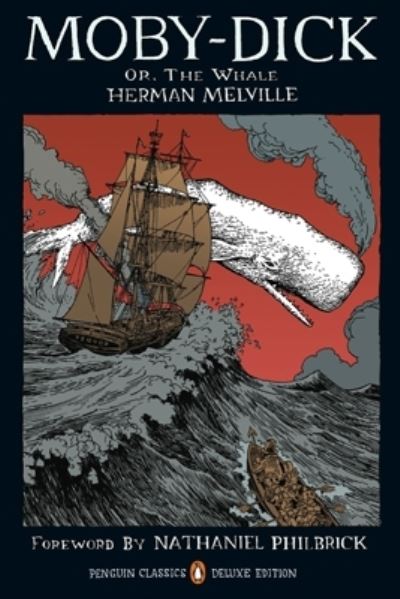
A swashbuckling adventure story of seemingly epic proportions. The plot
follows a half-crazed sea captain who seeks bitter revenge on a white
whale who previously deprived him of his legs. Extraordinary details of
ships, whale anatomy, and the nature of man make this novel intense and
deeply fascinating. The first line of Moby Dick, ‘Call me Ishmael,’ has
been described as one of the most immortal openings to any book in
literary history. A must read classic.

|
Synopsis
Moby-Dick or, The Whale by Herman Melville
Captain Ahab is an eerily compelling madman who focuses his distilled hatred and suffering (and that of generations before him) into the pursuit of a creature as vast, dangerous and unknowable as the sea itself. More than just a novel of adventure, this is a haunting social commentary populated with some of the most enduring characters in literature. Written with wonderfully redemptive humour, Moby Dick is a profound and timeless inquiry into character, faith and the nature of perception.
About the Author
|
|
Herman Melville was born Herman Melvill (the ‘e’ was added in the 1830s) on 1 August, 1819, in New York City to a wealthy importer.
The Melvilles moved to Albany after Herman’s father was bankrupted. His father died soon after and the young Herman worked variously as a farmer, bookkeeper, teacher and bank clerk. At the age of 20 he signed on as a deck hand of a trading ship, the St. Lawrence, sailing to Liverpool and back. Soon after his return he set sail for the South Pacific aboard the whaling ship Acusnet. In the Marquesas, Melville jumped ship and spent a month in the Taipi valley on the island of Nuku Hiva. Brought to Tahiti by an Australian whaler, Melville was taken ashore as a mutineer but escaped. He enlisted in the US Navy in Honolulu and sailed to Boston, where he was discharged in 1844.
Back in the US, he began to write, turning his experiences in the Pacific into several fictionalized travel books. Typee in 1846 was extremely successful.
In 1847 Melville married Elizabeth Shaw, the daughter of the Massachusetts Chief Justice. After a few years they and their family moved to Arrowhead, a farm in Pittsfield, where Melville started Moby Dick. During this time he met Nathaniel Hawthorne, who inspired him greatly.
Upon publication, Moby Dick received mixed reviews. His next novel, Pierre, fared worse. Seeking a steady income, Melville turned to magazine writing. In the late 1850s he embarked on a tour of the Holy Land, financed by his father-in-law. The trip inspired much of his future writing. Upon his return to the US Melville lectured extensively and began to write poetry almost exclusively. He failed to find a publisher for his poems and took a post as a deputy inspector of customs at New York port, a job he held for almost 20 years.
His relationship with his wife deteriorated so much in 1867 that they nearly separated. Later that year their son Malcolm died from a self-inflicted gunshot wound.
After his retirement Melville published two small volumes of poetry, dealing with the sea, art politics and sexuality. At his death on September 28, 1891, Melville left several uncompleted projects, including the novella Billy Budd, which remained unpublished until 1924.
More books by this author

Author 'Like for Like' recommendation |
|
|
|
 |
Book Info
|
 |
|