

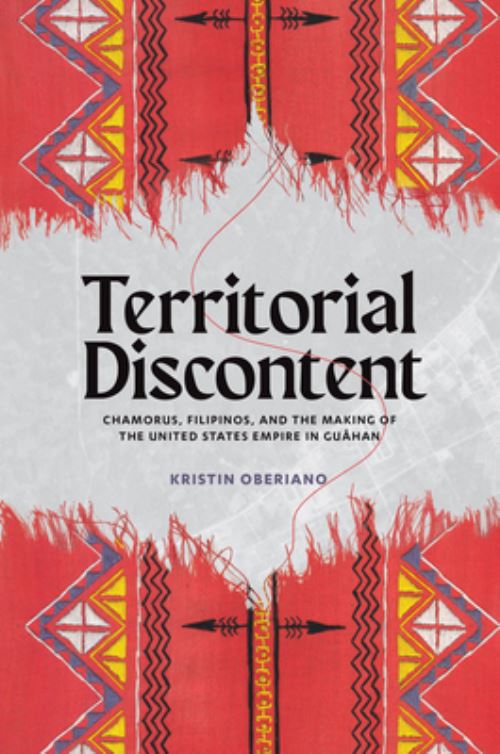
This one-hundred-year history of the island of Guåhan, also known as Guam, charts how Indigenous CHamorus and Filipino migrants navigated and negotiated the expansion of US imperialism and militarism in the Pacific. Throughout the twentieth century, CHamorus and Filipinos living in Guåhan expressed their discontent with the inequities created by the US empire. Instead of partaking in outright anticolonial movements, they advocated for liberal solutions such as individual rights, land ownership, economic opportunities, and US citizenship. Unraveling this entangled history, Kristin Oberiano exposes the limitations of liberalism in anticolonial resistance.
Tracing the long history of CHamoru-Filipino relations, from the exile of Filipino revolutionaries to Guåhan to the burgeoning CHamoru self-determination movement, Territorial Discontent grapples with the varied motives that propelled CHamorus and Filipinos to rely on the limited liberal promise of freedom. Oberiano reveals that implementing these solutions for one group too often required the continued colonization of the other, entrenching US colonialism in Guåhan and enflaming tensions between CHamorus and Filipinos. Examining these antagonisms, Oberiano argues that building relationships with the CHamoru virtue of inafa'maolek-"to make good"-can nurture CHamoru-Filipino solidarities and illuminate alternative possibilities for Guåhan's ongoing decolonization movement.
| ISBN: | 9781469693910 |
| Publication date: | 8th September 2026 |
| Author: | Kristin Oberiano |
| Publisher: | The University of North Carolina Press |
| Format: | Paperback |
| Pagination: | 314 pages |
| Genres: |
Social and cultural history Indigenous peoples History of the Americas |
This one-hundred-year history of the island of Guåhan, also known as Guam, charts how Indigenous CHamorus and Filipino migrants navigated and negotiated the expansion of US imperialism and militarism in the Pacific. Throughout the twentieth century, CHamorus and Filipinos living in Guåhan expressed their discontent with the inequities created by the US empire. Instead of partaking in outright anticolonial movements, they advocated for liberal solutions such as individual rights, land ownership, economic opportunities, and US citizenship.
Territorial Discontent features in the following genres: Social and cultural history, Indigenous peoples, History of the Americas
Hardback, Paperback. £22.49, down from the £24.99 cover price. Not Available.
Territorial Discontent was written by Kristin Oberiano and published by The University of North Carolina Press
Territorial Discontent has 314 pages
£22.49, reduced from £24.99. Not Available.