

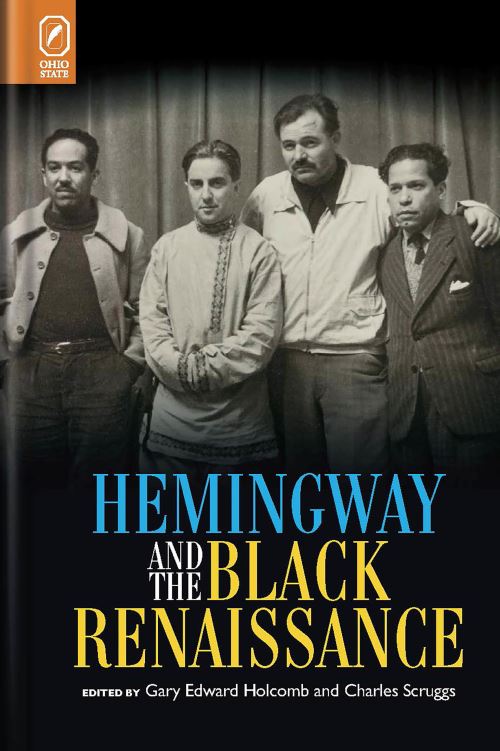
Hemingway and the Black Renaissance, edited by Gary Edward Holcomb and Charles Scruggs, explores a conspicuously overlooked topic: Hemingway's wide-ranging influence on writers from the Harlem Renaissance to the present day. An observable who's who of black writers-Ralph Ellison, James Baldwin, Langston Hughes, Claude McKay, Wallace Thurman, Chester Himes, Alex la Guma, Derek Walcott, Gayl Jones, and more-cite Hemingway as a vital influence.
This inspiration extends from style, Hemingway's minimalist art, to themes of isolation and loneliness, the dilemma of the expatriate, and the terrifying experience of living in a time of war. The relationship, nevertheless, was not unilateral, as in the case of Jean Toomer's 1923 hybrid, short-story cycle Cane, which influenced Hemingway's collage-like 1925 In Our Time. Just as important as Hemingway's influence, indeed, is the complex intertextuality, the multilateral conversation, between Hemingway and key black writers.
The diverse praises by black writers for Hemingway in fact signify that the white author's prose rises out of the same intensely American concerns that their own writings are formed on: the integrity of the human subject faced with social alienation, psychological violence, and psychic disillusionment. An understanding of this literary kinship ultimately initiates not only an appreciation of Hemingway's stimulus but also a perception of an insistent black presence at the core of Hemingway's writing.
| ISBN: | 9780814252383 |
| Publication date: | 29th May 2015 |
| Author: | Gary Edward Holcomb, Charles Scruggs |
| Publisher: | The Ohio State University Press an imprint of Ohio State University Press |
| Format: | Paperback |
| Pagination: | 246 pages |
| Genres: |
Literature: history and criticism |
Hemingway and the Black Renaissance, edited by Gary Edward Holcomb and Charles Scruggs, explores a conspicuously overlooked topic: Hemingway's wide-ranging influence on writers from the Harlem Renaissance to the present day. An observable who's who of black writers-Ralph Ellison, James Baldwin, Langston Hughes, Claude McKay, Wallace Thurman, Chester Himes, Alex la Guma, Derek Walcott, Gayl Jones, and more-cite Hemingway as a vital influence.
Hemingway and the Black Renaissance features in the following genres: Literature: history and criticism
Paperback. Not Available.
Hemingway and the Black Renaissance was written by Gary Edward Holcomb, Charles Scruggs and published by The Ohio State University Press an imprint of Ohio State University Press
Hemingway and the Black Renaissance has 246 pages