

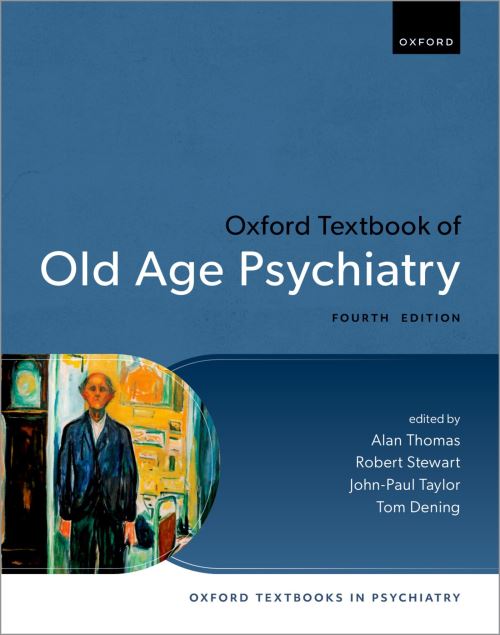
Health and social care services are most heavily used by older people, and mental health conditions, both organic and functional, have a particularly high impact as people age, not only through their direct consequences for those affected and their carers, but also their wider adverse effects on other common health conditions and 'frailty' more generally. Yet despite its importance, old age psychiatry has not been overburdened with textbooks.
However, the Oxford Textbook of Old Age Psychiatry has a long and noble ancestry. Beginning with Felix Post's Clinical Psychiatry of Late Life, back in 1965, it continued to develop with three editions of Psychiatry in the Elderly, edited by Robin Jacoby and Catherine Oppenheimer, first published in 1991, which over time became the Oxford Textbook of Old Age Psychiatry. This latest edition reflects the longstanding importance of this text and its unique coverage of not only all relevant clinical conditions but of services, ethics, and other wider aspects of clinical practice.
This fully updated fourth edition also includes new chapters examining Carers and Dementia, Eating Disorders, Autism and Neurodiversity, as well as other topics. The authors contributing to this book continue to be drawn from experts in the field from around the world, thereby enabling it to maintain relevancy to clinicians everywhere.
| ISBN: | 9780198902690 |
| Publication date: | 24th November 2026 |
| Author: | Tom Dening, Alan Thomas, Robert Stewart, JP Taylor |
| Publisher: | Oxford University Press an imprint of OUP OXFORD |
| Format: | Hardback |
| Pagination: | 1008 pages |
| Series: | Oxford Textbooks in Psychiatry |
| Genres: |
Psychiatry Geriatric medicine |
Health and social care services are most heavily used by older people, and mental health conditions, both organic and functional, have a particularly high impact as people age, not only through their direct consequences for those affected and their carers, but also their wider adverse effects on other common health conditions and 'frailty' more generally. Yet despite its importance, old age psychiatry has not been overburdened with textbooks.
Oxford Textbook of Old Age Psychiatry features in the following genres: Psychiatry, Geriatric medicine
Hardback. £162.00, down from the £180.00 cover price. Not Available.
Oxford Textbook of Old Age Psychiatry was written by Tom Dening, Alan Thomas, Robert Stewart, JP Taylor and published by Oxford University Press an imprint of OUP OXFORD
Oxford Textbook of Old Age Psychiatry has 1,008 pages
Yes it is part of Oxford Textbooks in Psychiatry series
£162.00, reduced from £180.00. Not Available.