

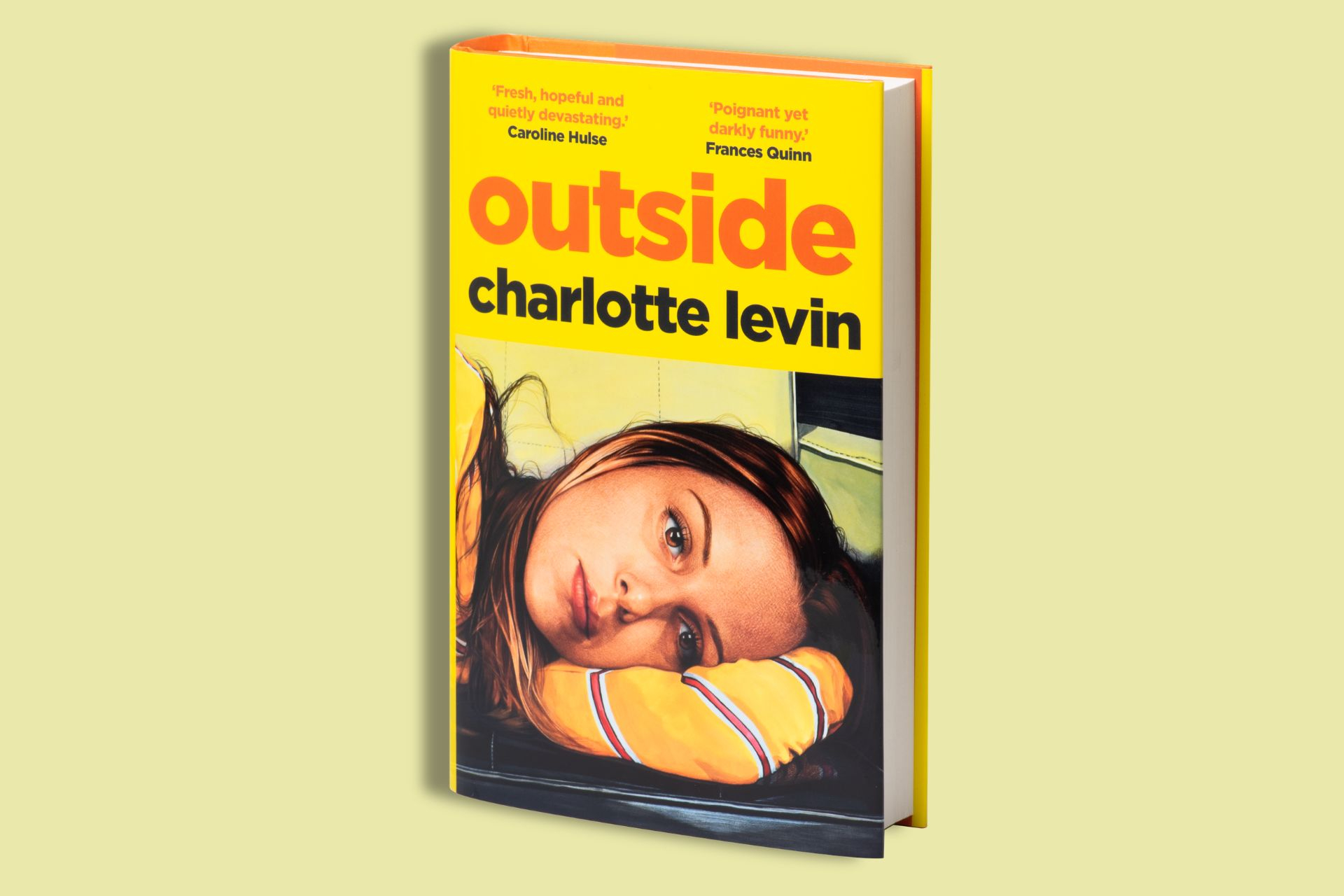
Charlotte Levin writes emotional yet darkly humorous character-led novels that centre on the morally grey, the outsiders, and those who could probably do with some therapy. Her gift for observation and nuances of character is confirmed in her latest release Outside. Chosen as a Star Book and our August Literary Pick of the Month, our Editorial Expert Joanne Owen proclaimed this book as "tender and ingeniously funny" and a "beautifully-written, beautifully-balanced novel explores grief, anxiety and love through the heart-rending, poignantly funny lens of an actress who’s trapped by life-shattering loss".
With a thorough LoveReading seal of approval we were beyond excited to find out some more about Charlotte Levin's inspiration for Outside as well as her writing journey. Keep reading to see what she had to say.
You can shop Outside from the links or by adding the book to the basket at the bottom of the page. With every purchase you get 10% off and we'll donate 25% of the cost of the book to a school of your choice. Let's work together to raise the next generation of readers.
Firstly, congratulations! Outside is an extraordinary novel. The way you balanced exploring anxiety, agoraphobia, and the deepest, messiest aspects of grief with humour and subtle, true-to-life touches of hope was brilliant. So, we wondered where the initial idea for the novel came from?
Thank you so much!
I am a lifelong sufferer of anxiety and have had agoraphobia for most of my adult life (though unlike Beatrice, I can go outside) and in my twenties, many moons ago, I wrote the beginnings of a play about an agoraphobic woman who fell in love with her postman. I never finished it, but the idea remained in the back of my mind, and it just felt the right time to write it albeit as a novel this time. There are many misconceptions about both anxiety disorders and agoraphobia, and I really wanted to shed light on the conditions and write about them authentically.
Did the novel require a great deal of research into, for example, anxiety and agoraphobia?
As I’ve suffered with the conditions for so long, I didn’t need to do extensive research. I did some, as everyone’s experiences are different and there are many ways in which agoraphobia and anxiety disorders can manifest, however some aspects are universal.
One of Outside’s many strengths is the depth that comes from the seamless, suspenseful “Before” and “Now” structure of the novel, with many of the “Before” episodes revealing details of Beatrice’s glamorous mother’s life. Firstly, did you always envisage the novel as having this structure? And secondly, did you write the mother character, Marianne, with a real person in mind, or perhaps a particular (jet) set of people?
One of the hardest parts of writing a novel for me is deciding how I’m going to tell the story, but I always knew that there would be at least two timelines, the ‘Now’ and the sections in the previous year within each season. Most agoraphobics can leave the house and go places (as can I) albeit with a plethora of different restrictions, so these past sections were important to show a varying scale of the condition. Weirdly, I had the season idea early on, even before Finn the gardener was introduced. It’s almost like I subconsciously knew he would exist all along. The ‘Before’ sections with her mother, Marianne, were added to the manuscript much later and were a breakthrough as they created a whole extra layer and mystery.
Marianne wasn’t based on any one particular person, but she was inspired by a variety of fabulous women such as Stevie Nicks, Marianne Faithful and Jane Birkin plus others.
Beatrice’s relationship with Irish gardener Finn is incredibly affecting. Did his character come to you in a pretty fully-formed state, or did he change through the course of writing?
Yes and no! As mentioned earlier, the story idea originally had a postman instead of a gardener. I called him Ben. Nicknamed Lego Ben because I couldn’t make him work at all and he was so stiff and terrible. But when I culled him in exchange for Finn the gardener, suddenly everything worked and he came fully-formed from the get-go.
On a different note, readers will surely also be struck by the character of Matisse, Beatrice’s talking parakeet. How did Matisse find his way into the novel?
Because much of the book is Beatrice alone in the house, I wanted her to have an animal companion, and a parakeet was perfect for many reasons. Firstly, although his vocabulary is very limited and sweary, his ability to talk offers Beatrice a soundboard and comic relief. But also, a wild bird is at odds with someone being locked in a house so Matisse is important thematically and metaphorically.
At a key moment, Finn remarks: “People enter and leave places, and it’s all for a reason, isn’t it? You just have to go for it sometimes, don’t you reckon?... Because if we don’t then we could miss opportunities. And missed opportunities are terrible things to live with. It’s much worse to regret the not...” To what extent does this capture what Outside is about?
Regrets and missed opportunities are strong themes that run through the book. Not just for Beatrice and Finn, but for Marianne and Gerard too. But everyone is just trying their best at any given moment and making decisions that they feel are right at the time (even if they’re not), or, at some points, the choices they make are all they’re capable of.
Related, what do you most hope readers will take from Outside?
One of my driving forces for writing the novel was to offer a better understanding of anxiety and agoraphobia. But also, that there is often humour within the darkness, that people are complex, and that there is always hope.
Outside, along with your previous novels If I Let You Go and If I Can't Have You, centres on damaged, complex characters - real people living with difficulties and dysfunction. What draws you to writing about the messiness of real life? And why is humour such an important part of that? Your books are often darkly comic, even when tackling challenging subjects.
I sometimes wish that wasn’t the case and I could come up with some high concept plot idea instead! But for me it all starts with a character or some kind of dysfunction. ‘Nice’, regulated, fully functioning characters are just not interesting to me! Though I always want them to end up happy in some way. I’m very much into psychology and what makes people tick and exploring that in my books is what I love the most. I use humour to deal with life and that just filters through into my work. I don’t particularly set out to make things funny, but I can’t help but see humour in so many situations, and I like its juxtaposition to the dark.
In your first two books, Manchester plays a starring role. Tell us three reasons why Manchester is so brilliant.
The first has got to be the people. I moved to London for many years then moved back to Manchester and it’s not a fallacy that folk are friendlier up here! Then connected to that is humour. There’s a definite unique Mancunian humour—it’s rather deadpan and sarcastic and can be quite dark. Then there’s the city itself, which has so many amazing shops, bars and restaurants and gorgeous architecture. I wish I could enjoy it more and hopefully will again one day.
Can you tell us about your journey to becoming an author.
Unlike most authors, I didn’t have the desire to write from an early age. Instead, like Beatrice I wanted to be an actress. In my early twenties I attended an acting course at the Royal Court Young People’s Theatre and wrote a scene for the end of course showcase, purely to give myself a big part. Afterwards, the creative director sent a message via the tutor to tell me to continue writing. I didn’t think much of it until in my early thirties when I wrote a play, which embarrassingly, and naively, I ripped from the typewriter without any edits or even reading it back and sent it to the National Theatre. Quite rightly it was rejected, but with some encouraging words which included a mention of ‘talent’.
Years later I embarked on my debut novel but still lacked the confidence to think I could ever get published. Fast forward again, now in my forties, I was shortlisted for the Mslexia Short Story Competition, which made me think that perhaps I could. But I still didn’t take it or myself seriously, until the death of my mum and dad within months of each other in 2015 when I reworked the novel as distraction from grief and a coping mechanism. The novel was shortlisted for the Andrea Badenoch Award, part of the New Writers North Awards which spurred me on with a new determination to get it published.
What impact did that shortlisting have on you in the early stages of your writing career? More broadly, how important do you think awards are for debut authors?
I don’t think it had much impact other than it was great to be able to add to my query letters to agents. Such awards can make your submission stand out as your writing has already been given a stamp of approval. But it’s certainly not a necessity for getting published. However, once you are published, winning awards can make a huge difference to the success of a book and to a writer’s career.
What are you working on now?
I’m a slow writer and it’s such an investment of time, that I need to make sure any project I go forth with is the right one and has legs. I have a couple of possibilities, and I am currently deciding which one to go with. I’m also mulling over a non-fiction project about anxiety that I have been wanting to do for a long time.
Finally, can you share your top five summer reading recommendations, either recent discoveries or old favourites that you love to return to?
There are a few books that I’ve recently read and loved. The Things We Never Say by Elizabeth Strout – this is the first Strout novel I’ve read, and I adored it so now must go and read all her others.
Quite different to that was Lost Lambs by Madeline Cash. This one made me jealous that I didn’t have Cash’s brain as I found it so funny and think she has an incredible voice.
I recently read London Falling by Patrick Radden Keefe. I don’t read lots of non-fiction, but thought this was great and so gripping, and frankly terrifying discovering a whole other layer to London.
Just this morning I finished Stoner by John Williams, and it has completely blown me away. People refer to it as a masterpiece and I think that word gets bandied around far too much, but this time it’s valid. Probably not the best holiday read unless you’re okay with bawling into your beach towel.
I’m not a big re-reader of books but end up returning to Breakfast at Tiffany’s by Truman Capote every few years. It’s perfect to read in one sitting if you’re on holiday or in the garden and I think it’s just wonderful.


Comments (0)
Leave A Reply
You must be logged in to post a comment.