

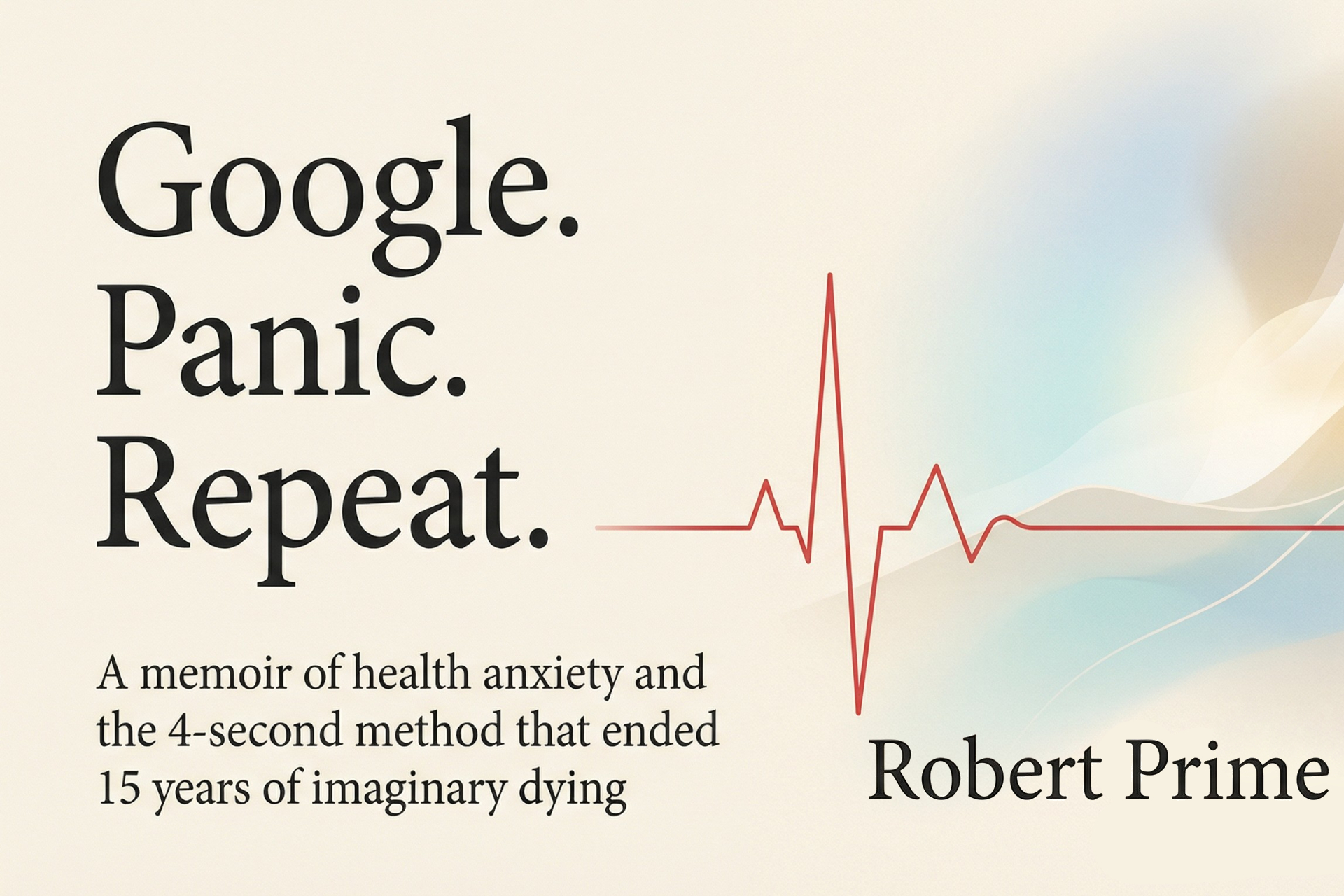
There are some books you don’t read as much as recognise yourself in.
Google. Panic. Repeat. by Rob Prime is one of those rare finds: a funny, painfully honest memoir that quietly becomes a practical guide for anyone living with health anxiety. Or supporting someone who is.
At its heart, this is a book about what happens when curiosity turns into compulsion, reassurance turns into panic, and Google becomes both comfort blanket and worst enemy. Rob charts his own experience of health anxiety with sharp self-awareness and humour, capturing the exhausting cycle many readers will instantly recognise: a symptom, a search, a spiral. And repeat.
What makes Google. Panic. Repeat. stand out is its tone. This isn’t a preachy self-help manual, nor is it a heavy clinical account. Instead, Prime blends memoir with genuinely useful insight, allowing readers to feel seen before they’re ever asked to change anything. It’s laugh-out-loud in places, uncomfortably familiar in others. And always compassionate.
Importantly, the book doesn’t promise a quick fix. What it offers instead is reassurance, perspective and language. It offers a way of understanding what health anxiety feels like from the inside, and how it can loosen its grip over time. That’s why it’s now being picked up and recommended by coaches working in the mental health and wellbeing space: it meets people exactly where they are.
For anyone stuck in the loop of symptom-spotting, late-night searching and “just one more check”, this book offers something powerful: permission to pause, laugh at the madness of it all, and realise you’re not broken. You're not alone.
Sometimes the most helpful books aren’t about having all the answers. They’re about helping you breathe again.
We had the opportunity to chat to Rob about his motivation his anxiety journey, and the impact his book is having.
Writing & Motivation
Q. What made you decide to write Google. Panic. Repeat. And why now?
A. I felt an obligation to. I have been 16 years now without any anxiety and yet before that I had non-stop anxiety, especially around health. There were no recovery stories and very few simple methods, so I wanted to write the book I wish was there when I needed it.
Q. Was there a moment when you realised your personal experience might help other people?
A. Actually, it was truly when I got my first review and someone said I had changed their life and they no longer had panic attacks. I wrote the book in that hope but truthfully, until I started getting feedback and seeing the actual effect, I was not sure.
Q. Writing honestly about anxiety can be exposing. What was the hardest part to put on the page?
A. Great question, and the hardest part was putting my name to the crazy stories I tell in the book. Saying that I have thought I had over 40 terminal illnesses is NOT easy for me and feels embarrassing. It is like writing about another person now, and the first version of the book did not have my name in it.
I felt that was not authentic and rewrote it, added my name and owned it all. There are stories in there that I would have been embarrassed to tell my kids, let alone the public. I am actually now proud of them as they show what I overcame, and if I can then others can.
Health Anxiety & Recognition
Q. Many readers say the book feels "uncomfortably familiar". Why do you think health anxiety resonates with so many people?
A. Health anxiety affects around one in 20 of the population. There is a stigma around it and of being a hypochondriac. There is also now so much access to information online, a lot of which can be inaccurate and leads to anxiety. I guess I wrote an extreme version of what many people have felt from time to time and what many people suffer with daily.
Q. How did humour help you both cope with and write about your experience?
It did not help me cope with it at the time, but it helped me to write about it. By mocking myself a little in the book, I found it easier to write about the details of what is actually a horribly debilitating state of mind and a serious issue. The line between humour and trivialising people's experience was something I was very conscious of, but I think I managed to strike the right balance.
Q. What do you wish you'd understood earlier about health anxiety?
A. That it is not a fear of health in many cases but a faulty mental alarm system and an addictive thought pattern. I read many books on fear of death, illness and they did nothing for me. It was only when I addressed the mental pattern and cut off the quest for reassurance that I became free of it.
Health was just a symptom of this thought pattern.
Google, Reassurance & Modern Life
Q. How has access to unlimited information changed the way anxiety shows up for people today?
A. Google paved the way for health anxiety sufferers to find almost limitless information. Unfortunately, this information will most often confirm what you want it to if you dig deep enough. For example, if you put "night sweats" into Google, it relates to all kinds of terrible diseases, but the fact is it also relates to having too many covers on the bed in summer and a host of harmless things. Then "flu-like symptoms" relates to a million bad things but also can be simply a bad cold.
I got so deep into stats that I could tell you survival statistics by cancer type, by demographic, by country, by year! Go back before the year 2000 and it would have been hard to feed that worry to that extent.
Q. Do you think health anxiety is more common now, or just more visible?
A. 100% more common and more visible. Screen attachment, access to huge amounts of information, less time outside and socialising are just a few reasons why anxiety is rising. I don't want to oversimplify things, but it feels a perfect storm for anxiety and I personally think it is very under-documented even now, due to stigmas.
Help Without the Hard Sell
Q. This isn't a traditional self-help book, yet many readers find it deeply helpful. Was that intentional?
A. Yes. I found self-help books very hard to get through on the whole. I read many of them. It doesn't really try to be a self-help book, more a memoir with a method. It is designed to give something simple to work on right away that is measurable. It is based on CBT, ACT and psychology, but it is nothing new or groundbreaking. It is just packaged in a way to appeal to simple brains like mine.
Q. What do you hope readers feel after finishing the book - even if nothing else changes immediately?
A. That it is possible to come out the other side of anxiety and to look for progress, not perfection. If you want a miracle overnight cure and it exists, I would love to read it. This is about untraining a mind that has been trained in a form of dysfunction and making slow and steady progress and celebrating that.
Impact & Reader Response
Q. Have any reader responses particularly stayed with you?
A. Yes! One lady thanked me for writing the book saying she had not had a panic attack since. This was before Christmas and she was able to enjoy it with her kids, and that it had changed her life. This honestly made me happier than pretty much anything I do in business. It was my first powerful review and it is incredible to think that it did that.
Q. If someone is stuck in the "Google. Panic. Repeat." cycle today, what's one small thing you'd want them to hear?
A. Check one minute less today. Build on that. Understand the pattern and how it feeds itself and break it. If you are worried, get tested and do not procrastinate. That is four things!
Q. What would you say to someone who feels embarrassed or ashamed about their anxiety?
A. Anxiety is unfortunately more than common. You are not alone and there is nothing to be embarrassed about at all. Just don't accept it as the norm for you - it doesn't have to be.
You can find out more at https://flipanxiety.com/
Comments (0)
Leave A Reply
You must be logged in to post a comment.